
Rail operators and rolling stock manufacturers are under pressure to do three things at once: cut vehicle weight, meet ever stricter fire safety standards, and keep whole-life maintenance costs down.
Advanced composite materials are increasingly the answer to all three, and their role in rail is expanding well beyond the interior cladding they were once known for.
This article looks at where composites are being used across rail and the standards that govern their use.
Where composites are used in rail
Composite materials are now starting to appear more than ever across parts of trains, and in a growing number of trackside and station applications:
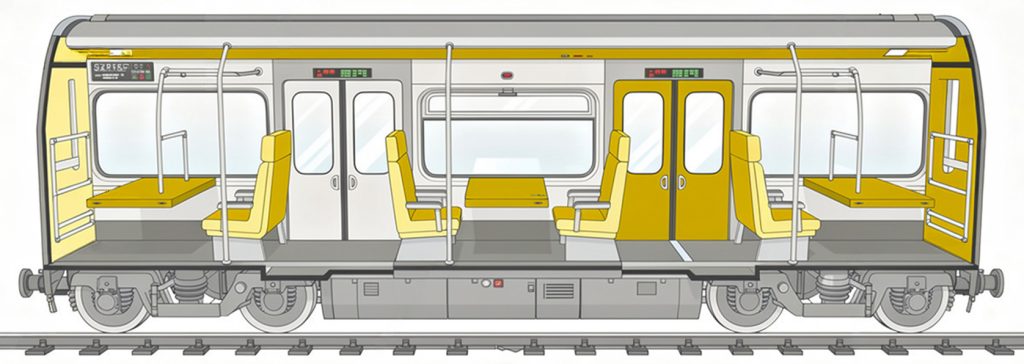
- Interior panels and linings. Composite sandwich panels combine reinforced outer skins with a lightweight honeycomb or foam core. They are widely used in rail interiors, including ceilings, wall linings, flooring, door panels and luggage racks, where they provide a strong, lightweight and adaptable alternative to traditional materials.
- Exterior and trackside applications. Composite materials can be used for platforms, footbridges and maintenance walkways, particularly where low weight, corrosion resistance and faster installation are important.
- HVAC, radomes and ancillary components. Glass fibre can be used for ducting, equipment housings and antenna covers where corrosion resistance, dimensional stability or electromagnetic transparency is required.
Why rail is turning to composites
- Weight reduction. Reducing vehicle mass can lower traction energy demand and, in some applications, help reduce loads on the track. Composites can provide useful weight savings where their strength, stiffness and durability requirements are carefully matched to the application.
- Corrosion and fatigue resistance. Unlike steel, composite materials do not rust and can provide strong resistance to corrosion and fatigue. This may help reduce maintenance requirements over the service life of a vehicle or structure, particularly in demanding environments.
- Design freedom and part consolidation. Composite moulding allows complex shapes and curved surfaces to be produced as a single part, reducing the fasteners, joints and assembly time associated with metal fabrication.
- Fire, smoke and toxicity (FST) performance. This is where rail differs most from other transport sectors. Because passengers may need extended evacuation time, particularly on underground and long-distance services, fire performance is treated as a first-order design requirement rather than an afterthought.
Fire safety: the standard that shapes every material choice
EN 45545, published in the UK as BS EN 45545, is the fire safety standard for railway vehicles.[1] It tests how materials behave in a fire, covering flammability, heat release, smoke density and toxicity.[2]
Each vehicle is assigned a Hazard Level, from HL1 to HL3, based on its operation and design.[1] HL3 is the toughest level and applies to vehicles such as metro and underground cars, where getting passengers out takes longer.[1] Materials used inside the vehicle are tested against the requirements for its level.[1]
References
[1] BSI. BS EN 45545: Railway applications. Fire protection on railway vehicles (series).
[2] Element. Rail Fire Testing: Certification and Compliance.
What this means for specifiers and OEMs
For engineers and procurement teams working on rail projects, three things are worth prioritising when selecting composite materials:
- Establish the applicable requirements first. Confirm EN 45545 hazard level compliance (and any relevant national requirements) before evaluating mechanical performance, not after.
- Core and resin compatibility. Material-system compatibility. Where prepregs, cores, adhesives and surface finishes are used together, manufacturers should confirm that the available fire-performance evidence reflects the intended component construction. Mechanical compatibility and processing requirements must also be considered.
- Supply chain reliability. Rail programmes run on long lead times and rigorous approval processes. A consistent, well-documented material supply reduces the risk of requalification delays further down the line.
How CAM supports rail programmes
Cristex Advanced Materials supplies prepregs, adhesive and surface films, honeycomb cores and other advanced materials for demanding composite applications.
For rail manufacturers, CAM can help identify material options based on the component’s mechanical, processing and fire-performance requirements. Where EN 45545-2 performance is required, the applicable product configuration, requirement set and supporting test evidence should be confirmed before a material is specified.
CAM works with customers and material manufacturers from initial material selection through to production supply, helping ensure that the reinforcement, resin system, core and processing route are suited to the intended application.
For support with material selection for an upcoming rail project, contact CAM at cam@cristex.co.uk or 01282 770666.